📚 Introduction
Welcome to the handbook.
This document hopes to guide you through the processes and concepts of working as a collaborator at Ideas on Board.
Welcome!
We're glad you're here.
Ideas on Board is a small, thoughtful consultancy working at the heart of the Linux and open-source community. Most of us have been writing software for decades - and most of us still prefer writing code to managing people. That’s not a flaw in the system; it’s part of who we are.
We work with hardware vendors, chipmakers, and device manufacturers to build open-source multimedia solutions, especially camera software for Linux systems. If you’re here, it likely means you care about the quality of your work, the freedom of your tools, and collaborating with people who take their craft seriously.
We’re a distributed team, working remotely across Europe and beyond. We catch up online, meet in person when we can, and generally try to keep things simple, transparent, and human. You’ll find autonomy here but also a shared sense of purpose that keeps us moving in the same direction.
This handbook is a living guide to how we work together. If anything feels unclear, ask. If you spot something missing, contribute. You’re part of this now.
Welcome aboard.
Onboarding Checklist
This checklist is here to guide your first steps and help you feel settled. Not everything will apply to everyone - feel free to adapt it based on your role or current project.
Week 1 – Getting Oriented
-
Set up your work email and relevant accounts
→ List of tools and platforms we use: [Insert link]
-
Join our communication channels
→ IRC / Matrix / chat channels: [Insert link or instructions]
-
Get access to relevant Git repositories
→ Repository list and access guidance: [Insert link]
-
Introduce yourself to the team
→ Preferred channel and suggested format: [Insert link]
-
Book a 30-min intro call with your main contact
→ Who this is: [Insert name/role/template invite]
-
Review the handbook and team resources
→ Start here: [Insert link]
-
Check for any team-wide updates or key discussions
→ Where to find this: [Insert link to mailing list, changelog, or update doc]
-
Set up your hardware / dev environment
→ Setup guide: [Insert link or checklist]
Week 2 – Getting into the Work
-
Review current priorities for your project
→ Project overview: [Insert link]
-
Get familiar with our development and review process
→ Guide to submitting patches, using CI, etc.: [Insert link]
-
Read through documentation for the codebase(s) you’ll be contributing to
→ Docs and READMEs: [Insert links]
-
Submit your first patch, doc edit, or contribution
→ Where to send it / how to tag reviewers: [Insert info]
-
Reach out with any questions or uncertainties
→ How we usually handle this: [Insert guidance]
-
Let us know if you're missing access or context
→ Who to talk to: [Insert contact]
Ongoing
-
Join our next in-person meetup (if timing aligns)
→ Upcoming dates and details: [Insert link]
-
Share any blockers or feedback with your main contact
→ We encourage regular check-ins and openness
-
Contribute to documentation or onboarding materials
→ Docs you can help improve: [Insert link]
-
Stay curious—this is a learning culture, and support is always nearby
Our Story
Ideas on Board started not with a grand plan, but with a contract.
Back in 2010, Laurent began working as a contractor for Nokia. What started as a short-term project turned into a long-term collaboration and slowly, a company began to take shape.
For the year, it was a one-person consultancy. Growth wasn’t the goal. But as the work expanded and long-standing collaborators joined the fold, it became clear that something more was forming: a values-led consultancy built on technical excellence, mutual trust, and a shared commitment to doing things the right way.
Today, Ideas on Board is a small team supporting open-source Linux development across the multimedia stack. We don’t build products. We don’t sell source code. We offer services - support, development, and technical leadership - to companies that need deep expertise and care about doing things well.
We’re best known for libcamera, a modern camera framework for Linux systems. It started as a risky idea in 2018 and has since grown into a respected project with wide adoption. It’s also become a proof point for our broader philosophy: that open-source development, when done right, is not only technically sound, it’s commercially viable, community-driven, and ethically better.
Our structure is flat. Our roles are fluid. And our culture is shaped by engineers who’ve stuck around because they believe in the work.
We’re not trying to scale for the sake of it. We grow when the work demands it - and when we find people who share our values.
⛰️ Our Mission
At Ideas on Board, we build high-quality, open-source software for Linux systems.
We work with hardware vendors, OEMs, and chipmakers to design and develop libre solutions that are robust, long-lasting, and deeply integrated with upstream communities. We don’t sell source code or licenses. We offer services - expertise, engineering, and long-term support - to clients who care about doing things the right way.
We exist to:
- Advance open-source ecosystems in areas traditionally dominated by closed solutions
- Help our customers deliver better products through transparency, quality, and technical depth
- Prove that open, ethical development can be commercially viable - and better for everyone
“We give everything away—but we make sure it’s worth paying for.”
This mission wasn’t crafted first and followed blindly. It emerged from how we already worked - rooted in values we’ve carried from the beginning.
Our Values & Principles
✨ Our Values & Principles
At Ideas on Board, the values came first. The mission followed.
We didn’t start out with a five-point plan or a pitch deck. We just worked on what mattered, in a way that felt right. Over time, some core principles have guided how we build software, collaborate with clients, and support each other as a team.
These aren’t corporate slogans. They’re the beliefs we return to, again and again.
🧠 Company Attributes of Association
The company develops, promotes, and provides open source and libre software and hardware solutions.
This is the simplest statement of what we’re here to do - and how. It’s not just what we build, it’s how we approach building it: in the open, for the long-term, and with full transparency.
💬 A Quote That Sums It Up
“Never be cruel.
Never be cowardly.
Never eat pears (unless you're hungry).
Hate is always foolish.
Love is always wise.
Always try to be nice.
Never fail to be kind.”
— Doctor Who (quoted by us)
We’ve joked about making this our official values statement. And maybe we’re not really joking. Because for a company rooted in technical depth and open-source complexity, we still believe kindness matters most.
🤝 Our Pledges
To our collaborators
We pledge to create, maintain, and improve a work environment that puts self-development and well-being at its core.
To our customers
- To provide our best service at our best value
- To support them with their needs
- Without fearing to contradict them - always in a kind and respectful way
🧭 How These Values Show Up Day to Day
💡 Do things the right way
We care about quality - not in a perfectionist way, but in a principled way. Whether it’s a kernel patch or a new hire, we ask: is this thoughtful? Is this aligned with what we believe in?
🛠 Build in the open
Open source isn’t just a business model, it’s an ethical stance. We want our software to remain valuable even if we disappear. That’s only possible when it's open, transparent, and community-driven.
⚖️ Choose autonomy over hierarchy
We don’t have managers in the traditional sense. People step into different roles as needed - technical, coaching, admin - and step back when it’s time to refocus. That flexibility is part of what keeps us learning and evolving.
💬 Be honest and kind
We don’t shy away from hard conversations - with clients or each other. But we always try to be constructive. This isn’t a place for passive aggression or ego. Clarity, respect, and directness go a long way.
🌱 Make space for growth
Not everyone wants to manage, and that’s fine. We believe in creating meaningful growth paths that don’t force people into roles they don’t want. Technical depth, mentorship, and initiative are all forms of leadership here.
🕊 Work flexibly, live fully
We’re remote-first and work across time zones. Some of us need uninterrupted time to think deeply. Others thrive on check-ins and shared debugging. We trust each other to manage our time, and make room for life, too.
“If the wind’s good, go windsurfing. Just let us know.”
Meeting Rhythms
🗓 Meeting Rhythms
We keep meetings light and purposeful. Most of our work is async and self-directed, but we do have a few regular touch points that help us stay connected and aligned across time zones and projects.
👥 Everyone Everywhere (Team-Wide Call)
When: Last Thursday of every month
Who: The whole team
Focus: Company-wide updates, key decisions, and shared context across teams and locations
Why it matters: This is where we step back from project work and look at the big picture. Whether you’re deep in client delivery or on a new initiative, this call helps everyone feel part of the same team.
📸 Libcamera Weekly
When: Every Tuesday, 9am UK time
Who: Libcamera contributors and relevant team members
Focus: Progress on the Libcamera project - technical discussions, updates, and coordination
Why it matters: Keeps the project moving smoothly, aligns contributors on ongoing work, and gives space to raise blockers or get input.
📅 Planning and Scheduling Call
When: Every second Tuesday, 10:15am UK time
Who: Management Team
Focus: Review and update the team assignments for the next 4 weeks, handle incoming sales.
Why it matters: Keep a clear overview of the whole team, and ensure resources are adequetely assigned. Review issues at a company mangement level.
🧠 Ad Hoc & Async
Beyond these two anchor points, most collaboration happens asynchronously via Git, email, and chat. We also spin up meetings when needed, especially when:
- Scoping a new feature or deliverable
- Making key decisions across people or regions
- Prepping for conferences, demos, or offsites
🆕 Introducing a New Meeting
If you're feeling a recurring need to align or check in, you can suggest a new rhythm. Just make sure:
- The purpose is clear
- It adds value beyond async communication
- The right people are included, and others aren’t pulled in unnecessarily
Start small, test it out, and iterate. If it works, we’ll add it here.
Communication Principles
Communication Principles
How we communicate with each other and the wider world
We work across time zones, use mostly open-source systems, and value thoughtful communication. We’re a small, technically-focused team, so we aim to strike the right balance between writing things down and just talking things through.
These principles are here to support clarity, reduce noise, and make it easier for people to do great work - whether they’ve been here for years or just joined.
1. Default to transparency
We aim to make information accessible unless there’s a good reason not to. This means:
- Writing things down in shared, version-controlled spaces.
- Preferring public threads over private chats (when appropriate).
- Avoiding single-person knowledge silos.
2. Communicate in context
Make it easy for others to follow your thinking, especially if they weren’t part of the original discussion. That means:
- Including key background and linking to related conversations.
- Using clear commit messages, issue summaries, or subject lines.
- Writing for clarity, not just speed.
3. Use the right medium for the job
We’re not strict about async vs. real-time, what matters is using the right tool for the situation. That might mean:
- Writing updates or proposals for shared review.
- Talking live when something needs rapid input or alignment.
- Combining both (e.g. a written summary followed by a short call).
4. Respect people’s time and focus
Whether working async or together, we try not to interrupt each other unnecessarily. That means:
- Being clear about urgency and expectations.
- Avoiding back-to-back meetings where possible.
- Allowing space for deep work and time away from the screen.
5. Be kind, direct, and constructive
We aim to give feedback with clarity and care. That means:
- Challenging ideas respectfully.
- Asking questions before assuming.
- Recognising good work and sharing credit.
Flexible Working
We’re a distributed team working across Europe, India, and Japan. Most of us are contractors, and we organise our work around trust, autonomy, and shared responsibility.
What flexibility means here
- We generally overlap during typical working hours in our respective time zones, which helps with coordination and collaboration.
- Within that, you're free to structure your day in the way that works for you - whether that’s starting early, taking a longer lunch, or finishing later.
- Need to step out to catch a wave or do the school run? No problem. Just keep others in the loop and make sure shared work stays unblocked.
Communicating availability
- Let others know your usual working pattern, especially if it differs from the norm.
- If you’ll be offline for a few hours, just give your team a heads-up.
- For longer periods away (e.g. holidays, personal time), update your status or calendar so we’re not left guessing.
Collaboration and coordination
- We don’t expect instant replies, but we do expect responsiveness within a reasonable window (typically within a working day).
- Use async tools where you can - but if something’s better discussed live, it’s fine to ask for a quick call.
- The goal is to work well together without micromanaging - we rely on trust, not time-tracking.
A note for full-time employees
If you're employed full-time, your working hours may be guided by your contract or local employment law. If you’re ever unsure what applies to you, check in with your point of contact.
Offsites
🏡 Offsites
Getting the whole team together in one place isn’t always easy, but it’s worth it.
We try to run in-person offsites a couple of times a year, usually tied to conferences, big projects, or just the chance to connect beyond the screen.
These gatherings aren’t about forced fun or heavy agendas. They're a mix of collaboration, problem-solving, and spending time together as humans, often in beautiful places, with good food and better conversation.
Types of Offsites
| Type | Why we do it | Typical length |
|---|---|---|
| CodeCamp | internal hacking + knowledge-sharing. | ~5 days |
| Conference co-location | We anchor around an industry event (e.g. Embedded Recipes, Nice) | 3–7 days |
| Customer on-site | Deep-dive with a client, often to kick-off or unblock a project. | 2–5 days |
What to expect
- Offsites usually last anywhere from a couple of days to around a week, and we aim to give everyone plenty of notice.
- Travel, accommodation, and food are covered by Ideas On Board.
- You’re expected to join if you're available - it’s part of how we work and build culture across time zones.
- There’s usually a balance of structured time (planning, working sessions) and free time (exploring, relaxing, catching up).
Planning and logistics
We know that travel isn’t always easy, especially across continents, and we do our best to plan with care and flexibility.
If you need a visa or have specific travel constraints, just flag it early and we’ll help however we can.
Time logging
It is still helpful for us to track time spent on travel and meetups.
When at a conference or on-site please log based on what you feel is appropriate. A default option could be to log 8 hours per day to one of the following:
For customer travel, please ensure that travel and on-site time is logged accordingly to a task in the customer project.
Tech Stack
These pages can help document how to use tooling within the Ideas on Board group.
🔐 Connecting to Restricted OFTC Channels via Matrix (Element)
This guide walks you through registering and authenticating your Matrix account with NickServ on OFTC, so you can access restricted channels via the Matrix IRC bridge.
✅ Overview
We're using the Matrix ↔ IRC bridge hosted on
matrix.org to access OFTC (irc.oftc.net), where IRC channels appear in this
format:
#_oftc_#<channel-name>:matrix.org
To join restricted channels, you need to:
- Set your IRC nickname
- Register it with NickServ
- Authenticate with the bridge using
!storepass
🔧 Step-by-Step Instructions
1. ✅ Set Your IRC Nickname
In Element Web:
-
Join the IRC bridge control room:
@oftc-irc:matrix.org -
Send the following command to set your desired IRC nick:
!nick irc.oftc.net YourDesiredNick
Replace
YourDesiredNickwith the nickname you want to use on OFTC.
To validate and test, you can force a reconnect with:
!reconnect
2. ✉️ Register with NickServ
Now, register your nickname with OFTC’s NickServ.
-
Start a direct message with NickServ by opening a new DM with this Matrix ID:
@_oftc_NickServ:matrix.org -
In that chat, send the following message:
REGISTER yourpassword youremail@example.com
You'll have to verify you're a human, and also you should receive a confirmation email from OFTC with instructions to verify the registration.
3. 🔐 Store Your NickServ Password
After confirming your registration, store your password with the Matrix bridge so it can auto-identify you when you connect.
-
Go back to the bridge control room:
@oftc-irc:matrix.org -
Send:
!storepass irc.oftc.net yourpassword
Replace
yourpasswordwith the one you used during registration.
4. 🎯 Join a Restricted Channel
You can now join channels like:
#_oftc_#<channel-name>:matrix.org
For example:
#_oftc_#linux-media:matrix.org
If the channel is invite-only or uses access control, you may still need to request access from a channel operator after authenticating.
The Ideas on Board oftc channel is restricted to members only. Before you attempt to join, ask someone in the team to add you:
From IRC:
/msg chanserv access ##iob add <newusernamehere> member
Once added as a member you can join the Ideas on Board IRC channel with:
/join #_oftc_##iob:matrix.org
✅ Check Your Identification Status
To confirm you're identified with NickServ, message it again with:
STATUS YourNick
2 (online, identified by password) seems to be a reasonable response.
ℹ️ Notes
- Use
irc.oftc.net(notoftcoroftc.org) in!nickand!storepasscommands. - Always use the Matrix ID
@_oftc_NickServ:matrix.orgto talk to NickServ via Matrix. - Talk to the ChanServ with
@_oftc_ChanServ:matrix.org - Join channels with
#_oftc_#channel_name:matrix.org
1:1 Meetings
1:1s belong to the report, not the lead. They’re for coaching, context and early problem-solving – not a live status read-out.
| Cadence | Owner | Typical length |
|---|---|---|
| Weekly or fortnightly | Report sets the agenda | 30–45 min |
How to run a good 1:1
- Report prepares - drop talking points into a template (see below) before the call.
- Lead reviews - skim in advance so the call goes deeper than status.
- Discuss & document - jot decisions or follow-ups in the same doc.
- Close with action - agree who’s doing what by when.
Why bother with a template?
- For you - captures wins, worries and priorities so nothing important slips.
- For your lead / main contact - early context lets them coach and unblock instead of doing real-time note taking.
- For the partnership - written notes turn promises into follow-ups and create a running log you can mine later for reviews or reflection.
Pick whichever template feels right for you - or make up your own if that serves you better.
Template library
Template options:
| Template | Good for |
|---|---|
| Weekly-lite | Simple running log. |
| Full agenda + stretch Qs | Deeper reflection, explicit goals & manager question bank. |
| Light check-in | Quick wellbeing pulse with optional structure. |
(Mix-and-match as you like - the goal is a conversation that helps you.)
Weekly lite
{{YEAR}}-W{{WEEK}}
What has been done
What will be done (in-progress)
Any issues
Other discussions
- How are you doing? How did the last week go?
- What would you like to talk about today?
- What are you proud of? Anything blocking you?
- Do you need any support? How can I help you?
- Anything else you’d like to talk about today?
Full agenda + stretch q’s
DATE: {{YYYY-MM-DD}}
1 Wins
What went well / was a highlight this week?
- 1
- 2
- 3
2 Updates
Last week I completed:
- 1
- 2
- 3
This week will succeed if I deliver:
- 1
- 2
- 3
3 Roadblocks / concerns / input needed
- 1
- 2
- 3
4 Personal development
Skill or knowledge I’m working on:
Action I took last week:
Action for this week:
Feedback prompts
- One thing I did well:
- One thing I could improve:
- Ask lead: What did you notice I did well? What could I improve?
- Feedback for lead: One thing you did well / could improve:
5 Stretch question
(Lead picks one from the list below.)
Stretch-question pick-list
Motivators & energy
- When do you feel at your best?
- Which part of your work is most / least energising?
Long-term growth
- What skills do you want to develop this year?
- Who in the company would you like to learn from?
Strategic thinking
- How do you prioritise your work?
- Describe a recent situation you’d handle differently next time.
Lead support
- What could I do to make your work easier?
- How useful was this 1-to-1 on a scale of 1-10?
Light check-in
Date: {{YYYY-MM-DD}}
Today’s check-in
Prefer to…
☐ Just talk ☐ Use light structure
| Question | Scale 1-5 (or Red/Yellow/Green) |
|---|---|
| How are you feeling today? | ☐ |
| How supported do you feel this week? | ☐ |
Quick topic gather (2-3 min)
| Your topics | My topics |
|---|---|
| • | • |
Discussion notes
Follow-ups / next steps
Closing
Is there anything else you need from me this week?
Review + Reflect
A Review & Reflect session is our chance to pause, look back and look ahead together.
| Item | Default |
|---|---|
| Frequency | Once a year minimum; twice if workloads allow |
| Length | 60-90 min |
| Who attends | You + your lead / manager |
The template
We capture each review in a Google Sheet:
▶︎ Make a copy of the “Review + Reflect” template
The sheet lists out the impact areas found in our Growth framework: Delivery, Team Impact + Initiative. There are two columns for a self grade and a lead grade plus space for notes. In addition there is a space for your lead / manager to reflect on the past 6/12 months from their perspective, and following your conversation.
How to use
- File → Make a copy into your own folder.
- Complete the “Self grade” and write bullets in the Summary page before the meeting.
- Share the sheet with your lead at least 48 h in advance.
Preparation checklist
| You (Contributor) | Your Lead / Manager |
|---|---|
| • Copy the template & fill self-reflection bullets. | |
| • Highlight 2–3 proud moments and 1–2 challenges. | |
| • Think about skills you want to grow in the next 6 months. | • Review the contributor’s objectives from the last period.• Gather concrete examples (positive & constructive). |
| • Block out meeting time with no interruptions. |
Psychological safety matters: be ready to talk frankly, listen actively and keep feedback constructive.
Meeting flow
- Company & team feedback (you first) – What’s working? What could be better?
- Self-reflection discussion – Walk through your bullets; lead adds observations.
- Competency deep-dive – Compare Self vs Lead grades; discuss gaps and bright spots.
- Next 6 months focus – Agree 2–3 measurable objectives and support needed.
- Close & next steps – Summarise actions, confirm who’s doing what and when.
After the session
- Lead / manager writes a summary in the sheet’s “Notes” column.
- Both parties tick off agreed actions in the weeks that follow.
- Remember: the door (and inbox) is always open. There is no need to wait a year to flag issues.
Annual Review
The objective of the annual 1:1 meetings are twofold: they provide a performance assessment for the employees and lay out paths for improvements, but also assess the performance of Ideas on Board towards the employees. They offer a channel to share constructive criticism both ways.
In order to be constructive, psychological aspects of the employer-employee relationship are crucial to take into account. A respectful but frank conversation requires a good match between how the leader expresses issues, and how the employee receives the message. This requires a preparation of the meeting tailored to each employee/leader, taking into account their communication abilities.
The 1:1 meetings are held yearly or twice a year. The frequency will be reviewed once the process is in place and tested.
Goals
In a large organization, 1:1 meetings are meant to make sure all employees will have a chance to talk to their manager. In a small team the requirement may not be as strong, but Ideas on Board is exceedingly relying on remote work, which makes these discussions important.
The employee shall
- have the opportunity to voice all his concerns and problems
- provide a self-review, without turning it into a confession exercise
When walking away from the meeting, the employee shall
- have improved morale and motivation
- know exactly what is expected from them for the next work period
- look at the future without fear
- know that all their concerns have been heard
The leader shall
- have clear meeting notes
- send a summary of the meeting to the employee for approval
- act on the feedback provided by the employee, recording tasks using the established process (this shall involve providing later feedback to the employee when those tasks have been handled)
Meeting Contents
The meeting covers three main topics, in the following order.
- Feedback on the company, by the employee
- Employee's assessment
- Objectives and planning for the future (all positive)
All feedback, in both directions, may be positive and negative but shall always be constructive.
Feedback on the company
This topic is addressed first, as it is expected to be easier for the employee and thus provides a way in the discussion without the employee feeling defensive.
Employee's assessment
Moving to the employee's assessment, the discussion turns towards the performance of the employee during the past work period. It covers both positive and negative criticism, constructive as always. The employee is first offered a chance to provide a self-assessment, to avoid switching immediately to a defensive attitude. The leader discusses the self-assessment, and optionally provides additional assessment in a second step to cover all the items that need to be addressed.
Key objectives
Finally, the meeting turns towards the future by defining key objectives for the next work period. Those objectives are decided in jointly by the employee and the leader. They shall be measurable.
Meeting Preparation
The leader shall prepare the meeting by performing the following tasks.
- List the employee's key objectives for the last work period
- Evaluate whether those key objectives have been reached
- Prepare an assessment of the employee's performance, making sure to include positive feedback
- If possible, obtain review of the evaluation from a second leader to avoid a too subjective evaluation
- Provide instructions to the employee to prepare for the meeting, and make sure the employee has received them and worked on them (for instance by requesting an acknowledgment of receipt if instructions are provided by e-mail)
Instructions for Employee
How precise should the instructions be ? How long in advance ?
Conducting the meeting
The 1:1 meeting is a very important occasion, and must be treated as such. No interruption shall be allowed, phone shall be set to silent mode. In a face-to- face setting, usage of computers should be minimized and avoided completely if possible. In a remote setting, usage of a computer is unavoidable but should not distract the participants. Instant message systems must be disconnect, and e-mails must not be checked. Notes should be taken on paper if possible, to avoid keyboard sounds.
Where applicable, and as widely as possible, the leader conducts the meeting by giving the employee the opportunity to talk first (as shown for instance by the self-assessment coming before the direct feedback from the leader).
Introduction
- Give a strategy summary at the beginning of the meeting ?
Key objectives
As through the rest of the meeting, the employee is given the opportunity to make proposals first. The leader shall however not forget that employees usually have a more limited view on the company's short-term and long-term objectives compared to leaders, so they may have trouble proposing appropriate key objectives. The leader shall always be prepared to either frame or directly drive the discussion when needed.
Concluding the meeting
While the 1:1 meeting is a special event, it is never the only way to discuss issues between the employee and their leader. The leader shall make this clear when concluding the meeting, by telling the employee that the leader's door (and e-mail inbox) is always open, both the next day for topics that may have been forgotten, and in the more distant future.
Example questions
These questions are designed to facilitate open and safe conversation, and develop and identify potential objectives and development paths for the future.
Order the questions from most generic to most specific, to offer the employee the option to drive the discussion themselves.
- Do you enjoy being a member of the team ?
- Does your team provide support whenever it's required or asked for ?
- Is there anything you need to raise, praise or concern, about working with
other team members ?
- We're not looking for you to stab your colleagues in the back, but for what problems we need to resolve
Assess how likely the employee is to continue working with us. Phrase questions with a large future time frame to provide perspectives into the future.
-
What part of your job do you find most meaningful and interesting ?
- Goal: find out what the employee likes to do and align it with the business needs (- Do you experience personal growth and development from your day-to-day role ?)
-
In the next two (to three) years, what personal and professional development opportunities do you wish you would have ?
-
Do you feel you're achieving a good work/life balance ? How can we improve it ?
-
Compared to what you've expected at first, does your current job match the expectations ?
- Is the job meeting your expectations ? If not, how can we improve it ?
-
Are you satisfied with your job overall ?
-
Is there anything I can do so that I can offer better coaching and support you ?
- Any training, area you want to develop ?
- Do you have all the resources you require ?
- (Important to end on a positive and constructive note)
How to Hire
Most of our team have come via conferences, open-source work and personal referrals.
We still advertise roles when needed, but network-first hiring is the default.
Role approval – No opening gets posted (or pursued) until Laurent and Kieran have both signed off on the need, budget and level. Likewise, an offer can’t be sent without their final thumbs-up.
| Stage | Who leads | Typical length | Output |
|---|---|---|---|
| -1 Role sign-off | Laurent + Kieran | – | Green-light given |
| 0 Referral / Inbound triage | Hiring lead | – | Candidate notes stored [link] |
| 1 Intro-fit call | Hiring lead | 30-45 min | Culture & comms fit notes |
| 2 Technical deep-dive | Two interviewers | 60–90 min | Skill-map & example notes |
| 3 Offer chat (incl. rate band + contract options) | Hiring lead | 30 min | Written offer |
Keep all notes in cloud.ideasonboard.com in the current Hiring year folder so any interviewer can pick up the thread.
Stage-by-stage detail
1 Intro-fit call
Purpose: check communication style, remote-work readiness, high-level technical alignment.
Template:
2 Technical deep-dive
Purpose: judge problem-solving and technical depth. Use open questions and let the candidate lead.
Question bank:
Tips
- Assess communication as you go - note clarity, structure and follow-up questions.
- Don’t “quiz”; pick 3-5 sections that match the role.
- Keep questions open; if the candidate stops short, nudge rather than interrogate.
3 Offer & contracting
- Offers should align with our Learning or Progressing step of the salary band only *(Mastery is ***reserved for internal team progression).
- Send draft contract and agree start date / notice period.
- Once offer is signed, prepare to onboard!
Intro Call
Intro-fit Call – {{YYYY-MM-DD}}
Candidate: {{Name}}
Role: {{Role / Level}}
Interviewers: {{You}}
1 Introductions
| Topic | Notes |
|---|---|
| What Ideas On Board does | |
| Candidate background |
2 Education & Career Snapshot
- Qualification & key projects
- Post-grad career highlights
3 Remote-work readiness
| Prompt | Notes |
|---|---|
| Current work setup (home, co-working…) | |
| Time-zone overlap challenges | |
| Strategies for staying connected |
4 Role alignment
- Why this role / why us?
- Notice period / contract status
- Salary expectations (band shared?)
5 Open Q&A
Candidate questions to us:
Decision checkpoint
- Culture / comms fit: ☐ Yes ☐ No
- Proceed to technical interview: ☐ Yes ☐ No
If “No”, state brief reason and follow up directly with the candidate to let them know your decision >> template:
To help us prepare for the discussions, would you be able to rate your knowledge for each of the skills below, using the following scale ? Try not to overestimate or underestimate your skills, this will only be used to steer the discussions, not to evaluate your fitness for the job.
- 0: You have never heard of the topic
- 2: You have used the technology before in a project
- 4: You are comfortable using the technology in a work environment
- 6: You use the skill on a regular basis and are proficient with it
- 8: You are a expert recognized by your peers on the topic
- 10: You have invented the technology
Skills:
- C
- C++
- Python
- Rust
- Git
- Linux kernel
- API design
- CPU-based image processing
- GPU-based image processing (OpenGL, Vulkan)
- ISP control algorithms (a.k.a. 3A+)
- Camera tuning
- Machine learning models design
- Machine learning training dataset creation
- Dev ops
- Project management
You can add up to three items of your choosing to the list if desired.
Technical Deep Dive
Pick the 3-5 sections most relevant to the role. Keep it conversational.
1 Imaging pipeline (15 min)
Choose appropriate questions from the following:
Camera Overview
“Walk me through what happens when a user takes a picture on a live-view camera.”
Follow-ups
- Issues you’ve seen in V4L2?
- Which ISP stages would you implement first and why? (see pipeline checklist)
ISP Blocks
Can you explain the components shown in this ISP diagram?
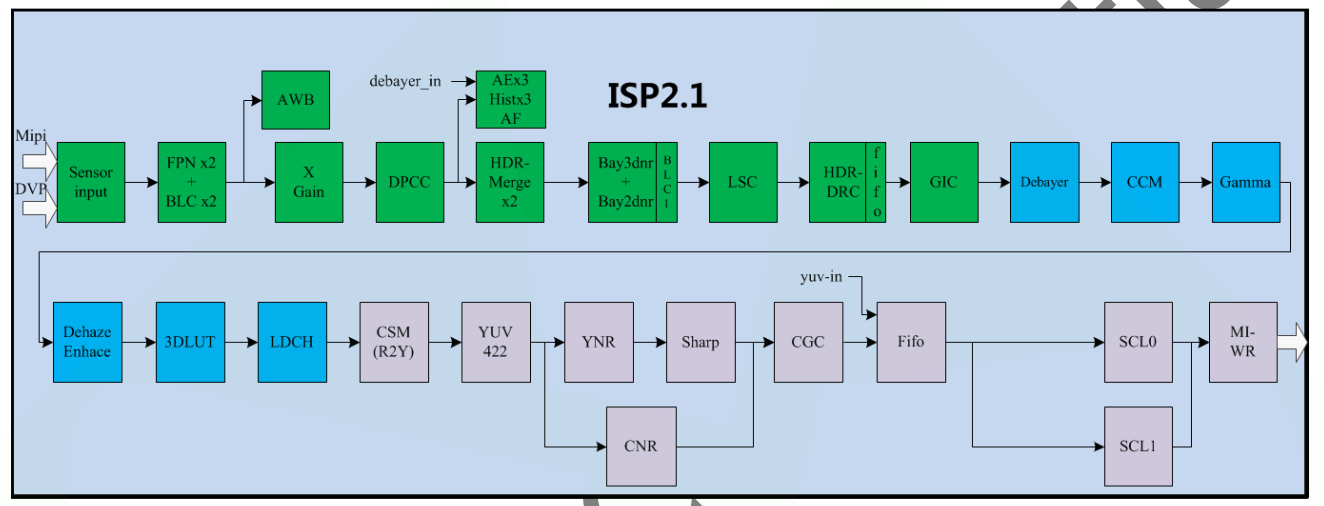
Q: Can you walk through the pipeline? A:
- MIPI
- FPN (Fixed Pattern Noise)
- BLC (Black Level Correction)
- AWB (Auto White Balance)
- Gain
- DPCC (Defective Pixel Correction)
- AE (Auto Exposure)
- AF (Auto Focus)
- Hist (Histogram)
- HDR-Merge (High Dynamic Range)
- Bayer 2DNR & 3DNR
- LSC (Lens Shading Correction)
- HDR DRC (HDR Dynamic Range Compression, includes tone mapping)
- GIC (Green Imbalance Correction)
- Debayer
- CCM (Colour Correction Matrix)
- Gamma
- Dehaze enhance
- 3D LUT
- LDCH (Lens Distorsion Correction Horizontal)
- CSM (R2Y) (Colour Space Matrix, RGB to YUV)
- YUV 422
- Sharpener
- CGC
- FIFO
- SCL (Scaler)
- MI-WR (Memory Interface WRite)
Q: Prioritise the order in which these would be implemented and why and how do they influence the image quality. A:
Image review
This image was taken during the bring up of the IPU3 through libcamera.
We were happy that we had images flowing through the pipeline - but what things can you see that are wrong with this image and what would you do to improve them?
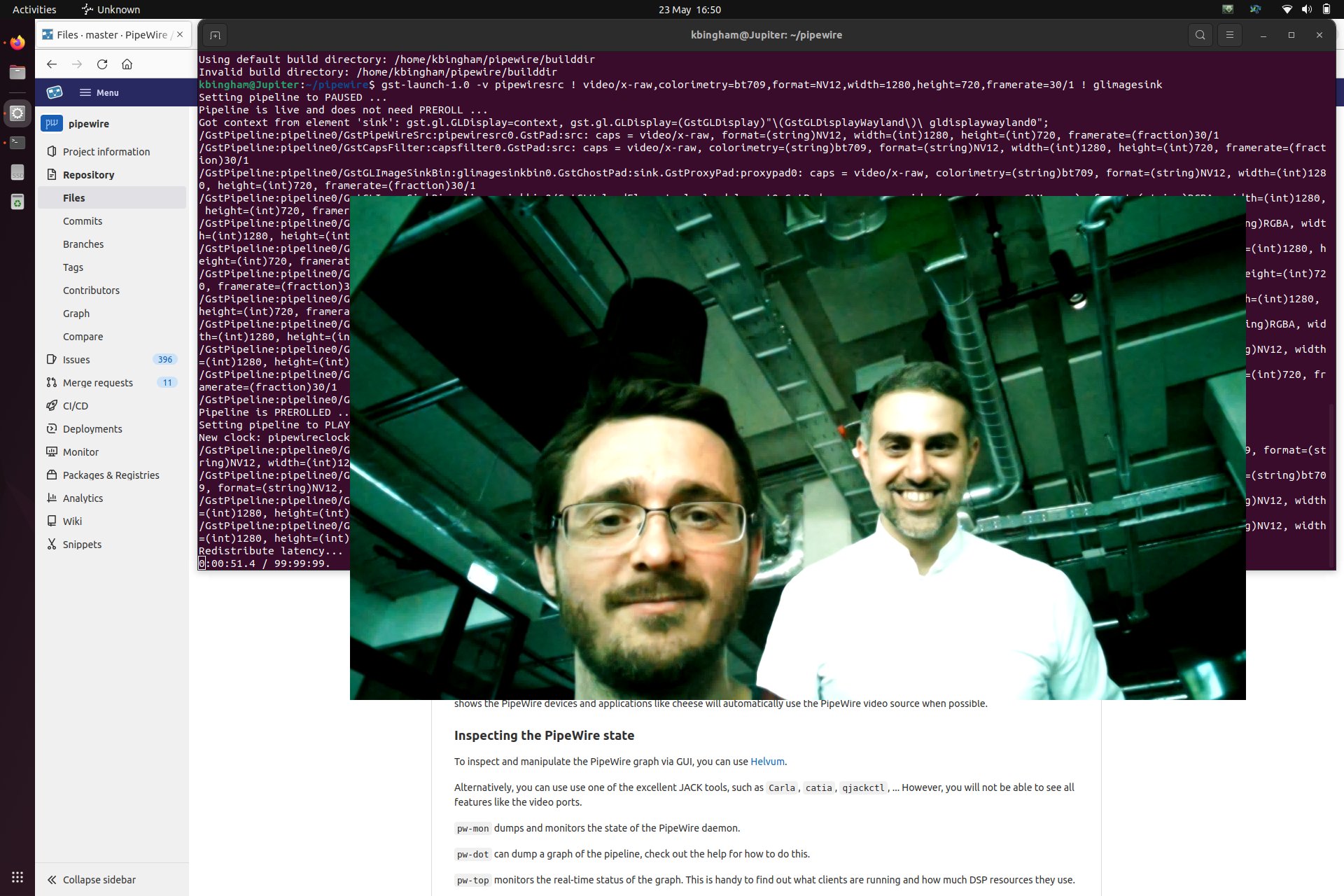
(We're looking for a realisation that the White balance is wrong visible from the green roof, and the image is overexposed visible from the white shirts).
2 Embedded Linux (10 min)
- Can you build a kernel from source?
- Experience with U-Boot / TFTP / NFS-root?
- How would you add code to a running kernel?
- Can you describe the differences between I2C / SPI / UART?
- When would you use each one ?
- What happens when your C code performs a read or write to a register?
3 Multimedia & Codecs (10 min)
- What’s a pixel format? Who defines FourCCs?
- Explain the difference between raw Bayer and YUV 4:2:2.
- What’s a codec? Name one lossless and one lossy example.
4 Open-source contribution (5 min)
- Have you submitted patches via e-mail before?
- Show me one commit you’re proud of - what problem did it solve?
5 Workflows and Coding (xxx min?)
Can you describe your work environment please?
- How familiar are you with Git, could you explain a git interactive rebase?
What work have you done with C++?
- Can you explain a shared pointer ?
- What does object orientation mean to you ?
- What happens when calling a virtual function?
6 Problem-solving scenario (up to 20 min)
“A user reports small oscillations in image brightness.”
How would you diagnose and fix this?
Look for: clarifying questions, tooling choice, systematic approach.
7 Systems thinking (fun open challenge)
“What happens when a user double-clicks an icon on the desktop?”
Let them roam from input event → compositor → kernel → storage → scheduler.
8 Soft Skills
Assume you're stuck for two days - what do you do ?
- Did you have any conflicts at work - and how did you solve or handle them ?
- What about if you've implemented something but your manager or project lead wants it done differently? How do you solve this conflict ?
- What do you expect from your project lead or manager ?
Scoring rubric (1–5)
| 1 | 3 | 5 |
|---|---|---|
| Basic familiarity | Solid working knowledge | Expert; teaches others |
Add scores inline in your notes; average later.
Rejection template
Subject: Update on your application to Ideas On Board
Hi {{First-name}},
Thank you for taking the time to speak with us about the {{Role title}} position.
After careful consideration, we’ve decided to move forward with other candidates whose experience is a closer match for our current needs.
We genuinely appreciated learning about your work on {{brief personalised reference – e.g. “your Jetson CSI-2 project”}} and enjoyed the conversation.
We’ll keep your details on file (max 12 months) and will reach out if a future opportunity aligns more closely with your profile.
In the meantime, thank you again for your interest in Ideas On Board, and we wish you every success in your ongoing projects.
Best,
{{Your name}}
Ideas On Board
How to Onboard
Every new joiner receives a short Mission Document to bring them up to speed with life at Ideas and Board, and the context for their role.
You can pull this together in less than an hour.
1. Copy-and-Fill Template
# Welcome to Ideas On Board, {{Name}}!

We’re thrilled to have you join the team.

---

## Your Mission (Why You’re Here)

Ideas On Board exists to push open-source multimedia forward.
The {{sub-team / project}} north star is **[fill-in: one-sentence purpose]**.

You were hired because **[fill-in: one-paragraph context – e.g. “we need deeper ISP expertise for Project X”]**.

### Key responsibilities (first 6-8 weeks)

- **R1** – [fill]
- **R2** – [fill]
- **R3** – [fill]

Success looks like: **[fill 2–3 bullets or leave blank until week 2]**.

---

## Your Onboarding Schedule (week 1)

| Day | Time | With whom | What | Notes |
|-----|------|-----------|------|-------|
| Mon | 10:00 CET | Lead | “Hello” call & handbook tour | VC link |
| Mon | PM | Self-paced | Set up systems / repo / chat
| Tue | 11:00 | {{Peer}} | Walk through current project|
| Tue | PM | Self | First small issue: {{link}} | |
| Thu | 15:00 | {{Customer}} (optional) | Sit-in on project call | |
| Fri | 16:00 | Lead | Week-1 retro (15 min) | |

*Adjust times / days freely.  The template is just a starting point.*

---

## Learning Path (60 days)

**Days 1–20 – Learn**
- 1
- 2
- 3

**Days 21–40 – Contribute**
- 1
- 2
- 3

**Days 41–60 – Own & Improve**
- 1
- 2
- 3

---

## People

| Name | Role (one line) | Time-zone |
|------|-----------------|-----------|

---

## Tools & Comms

| Purpose | Tool / Link |
|---------|-------------|
| Chat (all-hands) | **#[chat-general]** in {{platform}} |
| Code | Git repo `[fill]` |
| Issues / Kanban | `[fill – GitLab? GitHub Projects?]` |
| Handbooks | This repo, `handbook/` folder |
| Time-off notice | Email `hr@ideasonboard.com` |

Glossary / jargon: `[fill – optional]`

---

## First-Week Reflection (optional)

End of each day, jot quick answers and DM your lead:

* What was most interesting today?
* Anything unclear or blocking you?
* One thing that went well?

---

_Questions at any time → ping [name] or `hr@ideasonboard.com`._
2. Hiring Lead / Manager Checklist
- Copy template to [place] and tailor it to your new hire.
- Create calendar invites for the first-week slots you filled.
- Make sure the new joiner has [systems] access before Day 1.
- Share the completed doc with the joiner on their first call.
- Touch base at the end of Week 1 and Day 30 to reflect on the onboarding journey.
Base Rates + Progression Principles
We'll pay you fairly based on your level of expertise, impact, and responsibilities. Everyone has clear rate cards and understands how pay decisions are made. Our approach is simple, transparent, and designed to grow with us.
Purpose
🎣 attract and keep great people - offer competitive rates to attract talented engineers and keep them engaged in our mission
🥅 support our goals - ensure our approach helps us deliver exceptional open source solutions while maintaining sustainable growth
🫱🏼 recognise individual contribution - through progression within technical domain and beyond
Why this matters
We are an established, independent business that has grown organically since we started. Being able to pay our team (and our overheads), not just now, but in the long term, is hugely important to us. Therefore we intentionally grow in a way that is sustainable.
Our approach combines
- Competitive rate cards that reflect your technical expertise
- Profit sharing that recognises our collective success
- Sustainable financial planning to support long term stability and growth
This means that your expertise is rewarded through your rate card. Your contributions to Ideas on Board is recognised through profit sharing. We maintain the stability to support long term growth, and everyone benefits from our collective success.
Our Guiding Principles
💎 Keep it clear
- Your rate card matches your expertise level
- We review rates in June for eligible team members
- There is a clear process for everyone
🤝 Keep it fair
- Same level, same rate card
- Progression is based on expertise and impact, not negotiation abilities
- Balance local market realities with team fairness
🌍 Keep it sustainable
- Build for the long term
- Target competitive market rates for technical experts
- Balance team rewards with company investment
How this works
🔵 Structure
- 5 levels (L1 - L5)
- 3 stages per level: Learning → Progressing → Mastery
- Market-based rate cards
📅 Review Cycles
- One review cycle per year in June
- You’re eligible for rate review once per year
- Rate cards reviewed annually against market data
Our Framework and Pay
Our rate structure directly aligns with expertise and impact levels. Each level has specific expectations across:
📌 Delivery: consistently achieving individual, team and organisational goals
📌 Team impact: supporting the growth and success of teammates and colleagues
📌 Initiative: driving new opportunities and innovations
Level Overview + Rate Ranges
We use a five-level structure (L1-L5), with three progression stages within each level:
| Level | Scope | At a high level, what does each level mean | Learning | Progressing | Mastery |
|---|---|---|---|---|---|
| L1 | Individual Contributor | Given why, what, and how: DO | €45,000 | €54,280 | €61,950 |
| L2 | Specialist | Given why, and what: figure out HOW then DO | €59,200 | €67,850 | €76,700 |
| L3 | Technical Leadership | Given why, figure out WHAT, HOW, then DO | €76,700 | €88,205 | €99,710 |
| L4 | Strategic Direction | With increasing scope (usually at the level of critical & complex infrastructure / projects), given white space, figure out WHY, WHAT, HOW, then DO | €100,300 | €115,345 | €130,390 |
| L5 | Executive Vision | Make Ideas On Board successful both in terms of own scope and company ops as a whole | €129,800 | €149,270 | €168,740 |
Role Expectations by Level
Responsibilities build over time and reflect increasing impact, complexity, and leadership.
⚙️ Level 1 (L1)
💬 These are entry levels and individuals often progress through these more quickly. It's uncommon for people to stay within these job levels throughout their careers.
| Impact Area | Expectations |
|---|---|
| Delivery | - Consistently delivers high-quality code and documentation |
| - Follows best practices and standards in their work | |
| - Contributes to team projects and open source initiatives | |
| Team Impact | - Collaborates effectively within immediate team |
| - Participates actively in code reviews and technical discussions | |
| - Seeks guidance and feedback from more experienced developers | |
| Initiative | - Takes on additional responsibilities outside core role |
| - Identifies opportunities for process or tool improvements | |
| - Actively learns and contributes to relevant open source projects |
⚙️ Level 2 (L2)
💬 Responsibilities of L1 plus...
| Impact Area | Expectations |
|---|---|
| Delivery | - Designs and implements major components or features |
| - Breaks down complex projects into manageable tasks | |
| - Delivers complete solutions that meet requirements | |
| - Contributes to strategic open source projects | |
| Team Impact | - Mentors and supports junior developers |
| - Provides constructive feedback and code reviews | |
| - Represents the team in cross-functional initiatives | |
| - Collaborates with open source communities | |
| Initiative | - Leads improvements to team practices and processes |
| - Proactively identifies and solves challenges | |
| - Contributes to non-technical projects and initiatives | |
| - Advocates for open source best practices |
⚙️ Level 3 (L3)
💬 It's common for a successful career-level professional to reach this job level + the next and remain here for the entirety of their career. This is not considered stagnating as a majority of critical work is accomplished within this level.
| Impact Area | Expectations |
|---|---|
| Delivery | - Defines the technical strategy and roadmap for their area |
| - Leads the delivery of critical projects and initiatives | |
| - Ensures the quality and sustainability of key systems | |
| - Maintains and contributes to key open source projects | |
| Team Impact | - Provides expert guidance and support to others on the team |
| - Builds alignment and collaboration across the company | |
| - Represents the company at technical conferences and events | |
| - Recognised leader in open source communities | |
| Initiative | - Drives the adoption of innovative open source tools and methodologies |
| - Contributes to strategic planning and goal-setting | |
| - Leads key open source initiatives within and outside the company |
⚙️ Level 4 (L4)
💬 Responsibilities of IC3, plus...
| Impact Area | Expectations |
|---|---|
| Delivery | - Sets the long-term technical vision and direction |
| - Develops and executes on company roadmaps | |
| - Aligns technical strategy with business goals | |
| - Sponsors critical open source projects and initiatives | |
| Team Impact | - Coaches and mentors colleagues |
| - Builds and maintains strategic partnerships and alliances | |
| - Drives organisation-wide process and culture change | |
| - Advocates for open source at an industry level | |
| Initiative | - Defines the future direction for the company |
| - Contributes to new business models and revenue streams | |
| - Leads major cross-company initiatives | |
| - Influences the direction of key open source technologies and communities |
⚙️ Level 5 (L5)
💬 Responsibilities of IC4, plus...These are positions that are commonly reached after deep functional and/or professional experience. Moving into and between these job levels is often slower as the roles increase significantly in complexity and seniority.
| Impact Area | Expectations |
|---|---|
| Delivery | - Delivers on strategic commitments and outcomes |
| - Makes major decisions with far-reaching implications | |
| - Accountable for overall company performance and growth | |
| - Sets the overall open source strategy and engagement | |
| Team Impact | - Builds and empowers a world-class team |
| - Shapes and evolves the company culture and values | |
| - Represents the company on panels and advisory groups | |
| - Recognised as an open source expert and thought leader | |
| Initiative | - Sets the overall strategic vision and direction |
| - Identifies and pursues new market opportunities | |
| - Recognised as an industry leader and innovator |
🌐 Currency Conversion Approach
We publish bands in EUR first, then convert to other currencies :
| Target currency | Source for the rate | April-2025 rate we use |
|---|---|---|
| GBP | HMRC currency exchange average rates | 1 GBP → 1.1880 EUR |
| 1 EUR → 0.8418 EUR |
HMRC Average rates are published on 31st March and 31st December every year. We update the table every June review cycle (or sooner if ±10 % swings).
Progression stages:
Each level has three growth stages:
- Learning: developing capability in core responsibilities. Gaining familiarity with systems, tools, and expectations. May require direction or support to deliver consistently.
- Progressing: delivering reliably and independently across core responsibilities. Taking ownership of work within defined scope and starting to influence how things are done.
- Mastery: demonstrating deep expertise and consistent, high-quality contribution. Shaping direction within an area, solving complex problems, and elevating the work of others.
📅 Annual review cycle:
- Salaries are reviewed in June each year for eligible team members.
- Adjustments are based on market benchmarking and role progression.
Location-based compensation
We balance two priorities:
- Reward expertise fairly
- Keep the business sustainable
Base market & multipliers
- Helsinki is the base market (1.0x multiplier).
- A 0.7x multiplier applies to lower-cost regions where cost-of-living and salaries are significantly lower.
- This currently applies to Hungary, India, and other similarly indexed markets, reviewed annually.
Why this approach?
In plain terms: the multiplier reflects local market reality, not a discount on individual value.
Wherever you’re based, your band should land you slightly ahead of an equivalent engineer at a similar size, similar sector local company.
Rates are reviewed each June. If future data shows 0.7 × is no longer “above local median”, we’ll move it.
Where do we get our data?
We take data seriously because it drives fair compensation. Here’s where we get our information:
📊 Industry specific sources
- Pave market benchmarking
- Engineering job boards
- Data gathered from network
📊 Startup focused data
- PAVE benchmarking tool
- tech specific salary surveys
- try to ensure data gathered is from similar companies, so tech-led and headcount
- apply logic when using data from agencies removing anomalies where salaries are much higher or lower than the rest of the data
📊 General market data
- We look at live job adverts from linkedIn, indeed, and glassdoor, direct and via agencies
- Industry salary surveys
🗳️ The process
we compile and analyse this data annually, typically in April, to ensure our rates stay competitive and fair. When looking at data, we:
- focus on companies similar to our stage and size
- remove outliers that might skew the data
- look for patterns across multiple sources
want to help? 🤝
our benchmarking process is open to all. if you have access to robust compensation data or market insights that could help inform our rates, please reach out to Kieran. The more data points we have, the better.
Growth at Ideas on Board
there are two main ways to grow
🟰 within your current role
- progress through learning → progressing → mastery
- increase your impact and expertise
- earn rate increases as you develop
🔼 level promotion
- move to a new level when ready and role available
- start at “learning” in new band
- may reach new band in steps based on budget
as a small company, new roles aren’t always available but you can still grow and earn more in your current role. level changes will always be based on business needs and your readiness.
This is our first compensation philosophy and, like our company, it will evolve as we grow. While our core principles will remain consistent, we may refine specific elements based on feedback and business needs.
Compensation Reviews + Eligibility
This page outlines how base rates are reviewed each year and who is eligible for profit sharing at Ideas on Board.
We want to keep things clear, consistent, and fair - while staying light on process.
🔁 Base rate review
Base rates are reviewed once a year in June.
We use a three-stage structure within each level:
- Learning
- Progressing
- Mastery
Movement through these bands is based on your level, your growth over time, and the scope of your contribution. Not everyone will move every year - but the structure allows us to recognise growth where it’s happening.
You’re eligible for a base rate review if:
- You’ve been with the company for 6+ months
- You have not received a base rate change in the last 12 months
- You’re not already at the top of your current rate band
How it works:
- We check where you're mapped in the levelling framework
- We look at your growth - is the scope of your work evolving? Are you taking on more ownership or operating more independently?
- We apply the structure:
- Movement within your band (Learning → Progressing → Mastery)
- Or movement to a new level, if applicable
- Final decisions are made on any rate changes looking across the entire team to ensure consistency and fairness
- New rates (if applicable) take effect from [July 1st]
🎁 Profit sharing
Profit sharing is reviewed annually at the end of the financial year, and it’s designed to reflect the success of the business and the contribution of the team.
We aim to keep it simple. Profit sharing is separate from individual recognition - that’s what base rates are for.
You’re eligible for profit sharing if:
- You’re an employee or contractor
- You’ve actively contributed to company work during the financial year
- You’re meeting the expectations of your level
- You’re aligned with the team and our ways of working
- You’ve been with the company during the financial year (profit shares are prorated based on time in role)
- You’re still actively engaged with the company at the time of distribution
Profit Sharing
Profit Sharing
Profit sharing at Ideas on Board is how we share the company’s success with the team.
Each year, we allocate a bonus based on company performance. When things go well, everyone shares in that.
How it works
- A team bonus is allocated each year - typically up to 10% of salaries depending upon the company performance
- Bonuses are paid once a year, after we've closed the financial year and reviewed the numbers
Alongside team bonuses, we also retain some profit to reinvest in the business - for things like hiring, infrastructure, or marketing. This is reviewed and agreed each year.
So long as the company is profitable, the amount you receive through profit sharing is not affected by this retention. Team bonuses are allocated first.
After team bonuses and reinvestment decisions are made, any remaining profit is shared among partners.
Who’s eligible
You’re eligible for profit sharing if:
- You’re an employee or contractor
- You’ve been actively contributing to company work during the year
- You’re meeting expectations in your role
- You’ve worked with us for part of the year (your share is prorated)
- You’re still under contract when profit sharing is paid
When it happens
Profit sharing is reviewed at the end of the financial year, and paid out once the final accounts are confirmed.
What it’s based on
- Your time in role during the year
- This is a team bonus, not linked to individual contributions
- Recognition for individual growth happens separately, through base rate reviews
Time off + holidays
We believe in sustainable work, which means making space to rest, recharge and step away when needed.
We handle time-off differently for contractors and employees, because employment law treats them differently. Whatever your status, transparency is key: let the team know early and keep shared work moving.
Contractors
You are trusted to manage your own time, whether that’s a long weekend, a holiday or stepping away for personal reasons.
- Health first: take sick days as needed; tell someone when you’re offline.
- Guideline, not entitlement: aim for roughly 35 days per year (including local public holidays). It’s a wellbeing target, not a contractual bank - unused days don’t accrue or get paid out.
- Tell us: email
hr@ideasonboard.comwith the dates, plus a short hand-off note if you’re on a time-critical task. - As a guideline, please inform hr@ideasonboard.com with a notice of at least twice the duration of time-off
Full-time employees
Your paid-leave entitlement is set by your contract and local labour law.
- Days accrue monthly and any unused balance will be paid out if you leave, in line with legislation.
- Book leave by emailing
hr@ideasonboard.com; the days are logged in the shared spreadsheet so we stay compliant. - As a guideline, please inform hr@ideasonboard.com with a notice of at least twice the duration of time-off
Sick days
If you’re unwell, your health comes first. Take the time you need to recover.
- Let someone on your project know as soon as you can.
- If you’ll be off more than a couple of days, give a rough return date (update later if it changes).
Public holidays
We observe local public-holiday totals, but not necessarily the exact days.
- Feel free to swap: if you’d rather work the Easter Monday bank holiday and take the Tuesday off instead, that’s fine, just communicate it.
- Contractors: the day you pick counts toward your ~35-day wellbeing target.
- Employees: the day still comes out of your contractual pot, so swapping doesn’t change your overall balance.
Let the team know which day you’re taking so projects stay covered; no other approval needed.
Personal days & unexpected life stuff
Life doesn’t always line up neatly with work. Need to step away for a day (or a few hours) for something personal? Just tell the team - we trust your judgement.
How to communicate time-off
| Break length | What to do |
|---|---|
| A few hours | Update your status or drop a quick message. |
| Multiple days | Email hr@ideasonboard.com, add an out-of-office block to your calendar and ping anyone covering for you. |
That’s it - there is no formal approval queue. We rely on everyone’s professionalism to keep projects covered while protecting time to rest.
Logging time off
We know that life changes fast and sometimes what gets notified to hr@ideasonboard.com doesn't match reality.
Logging goes to the IOB Common project at https://projects.ideasonboard.com/projects/iob-common/work_packages
Please ensure that you log actual time taken off to open project accordingly:
| OP Task | Description |
|---|---|
| OP-546 | Time Off (top level generic) |
| OP-545 | Sick Leave |
| OP-544 | Personal Holidays |
| OP-1234 | National Holidays |
Parental leave
Because most of us work as contractors across multiple jurisdictions, parental-leave rules differ. Our baseline commitment is:
- Two weeks paid leave at full day-rate for any new parent (birthing, adopting, or supporting).
- Additional leave: regulations vary by country; talk to your manager to tailor a plan that respects local law and project needs.
- Keep us posted early - email
hr@ideasonboard.comas soon as you have approximate dates.
Military Projects Policy
If Ideas on Board is contacted with a project that may have military connections or prospects, we will review the project and raise this with the team.
No one will be forced to work on a project that makes them uncomfortable, and at a simple level if a majority of the team rejects a project the project can be rejected to the customer.
It may not always be clear or stated that a project has military use cases, and as part of the project research process Ideas on Board should investigate the target use cases as part of it's due dilligence.
It is a company policy that the company must be informed of the use case for any project before we can accept it, to ensure we always make a fully informed decision on our participation and involvement.
Learning Budget
While we have no formal learning budget, we expect you to spend time learning: our world moves fast.
| What we fund | Details |
|---|---|
| **LWN.net subscription** | Provided for everyone. |
| Conference attendance | 100 % travel + ticket if you submit & deliver a talk. One conference/yr minimum; more on case-by-case basis. |
| Books, courses, certifications | No formal cap. Pitch us - if it levels up your craft, we’ll usually say yes. |
| Work-time learning | Up to 1 day per week may be spent on community OSS contributions or skill deep-dives that benefit the team. If you’re interested in this, talk to Kieran or Laurent. |